
Years ago, a woman I’ll call Darlene sat across from me in Sunday school. She was older, had come to faith later in life, and now carried a zealous, unpolished faith, deeply aware of the contrast between her past and her Christian life.
Darlene held a strong conviction about public schools. She opposed them on moral and spiritual grounds and expressed gratitude that we homeschooled our children.
I replied, “Even if schools were gospel-centered mini-seminaries, I still wouldn’t send my children.”
Darlene was surprised. Our shared homeschooling conviction came from different foundations, mine rooted in beliefs about fatherhood, discipleship, and responsibility.
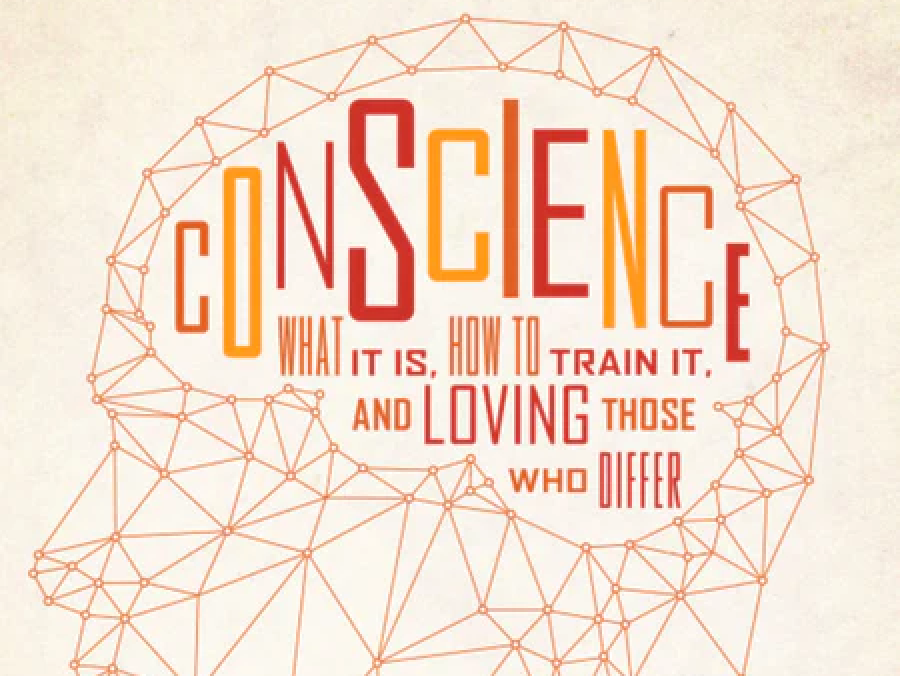
Looking back, I see I could have communicated better. Time improves delivery, even when convictions stay the same. I lacked the vocabulary then. Andrew David Naselli and J. D. Crowley’s Conscience: What It Is, How to Train It, and Loving Those Who Differ (Crossway, 2016) is the book I wish I had read before that conversation. With a foreword by D. A. Carson, it has now reached its tenth anniversary, and it remains the best short treatment I know of a neglected question: how our handling of conscience shapes doctrine, liberty, and love.
What the Book Argues
Naselli and Crowley define conscience as “your consciousness of what you believe is right and wrong.” That definition is simple, but it is not simplistic. The conscience is not the Holy Spirit. It is not Scripture. It is not infallible. It is not your pastor, your parents, your favorite theologian, your preferred commentator, or the collected moral instincts of your church culture. But neither is it nothing.
God made human beings as moral creatures. We do not merely act; we approve or accuse ourselves as we act. We sense guilt, hesitation, shame, peace, confidence, relief, fear, and moral urgency. Sometimes those inner judgments correspond rightly to God’s Word. Sometimes they do not. This is one of the book’s central contributions, and the authors state it with a clarity worth memorizing: your conscience is a gift from God, but your conscience is not God.
From that single distinction, the whole argument unfolds. Because the conscience is a gift, we must not violate it. Paul says, “whatever does not proceed from faith is sin” (Romans 14:23), and a Christian who acts against what he believes God forbids is training his soul in the posture of disobedience. But because the conscience is not God, we must not enthrone it either, treating our own inner alarm as divine law over everyone else. Lose the first truth, and you become careless. Lose the second, and you become a legalist. The authors refuse to let us resolve that tension cheaply, and the refusal is the heart of the book.
Two further moves complete the argument. First, the conscience must be calibrated. Scripture speaks of it as weak, defiled, seared, emboldened, clean, and good, which means it is not fixed in perfect accuracy at birth or even at conversion. It must be trained. Peter on the rooftop in Acts 10 is a great example: his recoil at the unclean animals is sincere, not a game, and yet it needs recalibration because Christ has fulfilled the categories that shaped his instincts. Second, calibrated consciences must still learn to live together. The book’s center of gravity is Romans 14 and 1 Corinthians 8–10, where Paul addresses real believers who genuinely disagree, some eat with thanksgiving, others cannot; some observe days, others do not, and refuse to flatten the issue. He does not tell the weak to grow up, nor the strong to surrender all freedom. He grounds their unity not in shared preferences but in the fact that God has welcomed them both.
Where It Is Strong
There is a great deal to commend here, and I want to name it plainly before I press on with the book at all.
It is clear. Naselli and Crowley write for ordinary Christians, not merely for pastors and seminarians. Many believers wrestle with conscience questions every week without any categories for what they are experiencing; this book hands them language without burying them.
It is biblical. The authors are not offering generic advice about tolerance or conflict resolution. They reason from Scripture, and the book serves as a model for thinking Christianly about moral disagreement, not just a set of conclusions.
It is charitable without being mushy, harder than it sounds. Some books on unity achieve peace by sanding down conviction; others defend conviction in a way that seems to relish conflict. Conscience aims at truth-governed love, taking conscience seriously without pretending every conscience is equally correct.
And its cross-cultural reflection is a real gift. Crowley’s missionary experience gives the book a depth that comfortable American church discussions often lack. It is one thing to discuss conscience in a classroom; it is another to ask how conscience functions when the gospel crosses cultures, languages, food practices, and inherited moral assumptions. Missionary contexts force questions that the rest of us can avoid.
Beneath all of it runs the book’s quiet pastoral service: it exposes how easily Christians misread one another. The brother with the stricter conscience may not be trying to control you; he may be trying to obey God with the light he has. The sister who feels free may not be compromising; she may understand something you do not yet understand. Either may be wrong; that is the point. Without patience, humility, and Scripture, conscience disagreements curdle into character judgments.
Testing the Categories at Ten Years
A book review at an anniversary can ask a sharper question than “did this age well?” The better question is whether the book’s categories still clarify our thinking after a decade of pressure. To test that, I wrote to Dr. Naselli with several questions, and his answers sharpened the book rather than softened it.
I asked whether, after ten years, he had reconsidered where the line falls between genuinely disputable matters and issues Scripture addresses more directly than we first thought. He was candid: he had thought about these things a great deal and would say some things differently now. One example he offered was that he would delete “capitalism vs. socialism” from the book’s list of disputable matters if that list implied socialism is consistent with the Bible.
That admission does not undercut the book. It demonstrates the book’s own thesis. Consciences and categories must be calibrated by truth, and sometimes time and further reflection reveal that an issue we once filed too quickly under “disputable” actually requires more careful biblical reasoning. The fact that Christians disagree about something does not, by itself, prove Scripture is unclear. Sometimes disagreement reveals liberty. Other times, it reveals that the church needs better teaching. “Christians disagree” is simply not the same claim as “God has not spoken.”
I also asked about a danger that has only grown more visible over the decade: that a robust doctrine of conscience and Christian liberty can be co-opted to avoid clear biblical positions under the guise of charity. He agreed that the risk is real. That may be one of the most important cautions for readers today. The category of conscience is biblical and necessary, but like every good category, it can be abused. “Do not bind consciences” can be a faithful warning against legalism, or it can become a hiding place for teachers who simply do not want to say what God has said. That is not a failure of the doctrine. It is a failure to apply the doctrine under the authority of Scripture.
The same point cuts in the other direction, which is why I pressed on triage. Theological triage is a genuine gift: some doctrines are essential to the gospel, others are necessary for church unity, and others are compatible with real cooperation despite disagreement. A church that treats every disagreement as equally serious becomes brittle and sectarian. But Dr. Naselli named the opposite abuse directly; some Christians misuse triage by concluding that nearly everything below tier one is “a conscience issue” on which it would be wrong to bind anyone. His example was God's design for men and women in the home and the church: the complementarian conviction that God assigns distinct roles to husband and wife, and reserves the office of elder to qualified men. That may not be a first-order doctrine in the way the Trinity or justification are, but it is still a matter where God has spoken, and there, he argued, pastors should bind consciences to what God has revealed.
That is a needed word in both directions at once. Pastors must not bind consciences with their own preferences, turning personality, strategy, or cultural background into law. But neither may they refuse to bind where God Himself has bound. To preach the Word is, in part, to say, “Thus says the Lord,” and when the Lord has spoken, the conscience must yield.
Where I Would Press Further
My criticisms are not reasons to skip the book. There are reasons to read it and then keep reading.
First, I would press harder on the role of the church and its officers. The book is excellent on peer-to-peer relationships. How do I love the brother whose conscience differs from mine? But churches also face institutional questions that the book mostly leaves open. What part do elders play in helping a congregation discern whether a matter is genuinely disputable? When should they patiently leave room for liberty, and when must they teach with clarity even if some cry “binding”? I asked Dr. Naselli whether he wished the book had said more here. His answer was carefully drawn: pastors do not determine such matters, but they are responsible to shepherd the flock by teaching them, and he allowed, “Sure, we could say more about that.” That distinction is exactly right. Pastors are not lords of the conscience, but they are shepherds of souls. They do not invent God’s law, but they must teach it. In my own training toward eldership, I feel the weight of this more and more: the theology is often the easier part, and the shepherding is the harder.
Second, and most importantly, I would press the book further toward Calvary. The conscience does not merely need training; it needs cleansing. Hebrews tells us that the blood of Christ purifies our conscience from dead works to serve the living God (Hebrews 9:14). The book does not deny this, but the pastoral weight of this truth deserves more room than it gets. Many Christians live under the tyranny of an accusing conscience, replaying old sins and old shame, knowing in some doctrinal sense that Christ forgives while their conscience still treats His blood as insufficient for their particular stain. That is not humility. It only feels like humility. It is a refusal to let Christ have the final word. The gospel does not quiet the conscience by pretending sin is small; it quiets the accusation by showing that Christ is sufficient. The conscience says, “You are guilty,” and apart from Christ it is right, but the gospel says, “Christ has borne your guilt.” A conscience that has not been cleansed at the cross will either despair under its guilt or try to justify itself by rule-keeping, and both roads lead away from freedom. We must train the conscience. But first, we must bring it to Christ.
Third, I would want more on the space between what is forbidden and what is wise. Some decisions are neither commanded nor forbidden and yet remain spiritually significant. A Christian can have freedom in principle and still make a foolish choice in practice. Wisdom is not the same as permission; prudence is not legalism. We need a category for saying, “This may not be sin in itself, but it may still be unwise, unhelpful, or dangerous here.”
Underneath all three runs an older Protestant treasure the book honors but could lean on harder: God alone is Lord of the conscience. Both the Westminster Confession and the Second London Baptist Confession use that exact language. No human authority, not the state, not the church, not a pastor, not a family, not a movement, not even your own anxious internal voice, may bind faith or obedience apart from God’s Word. But that same tradition teaches that Scripture binds not only by explicit statement but by good and necessary consequence. So we cannot only ask, “Is there a verse that says this exact thing in these exact words?” We must also ask what the whole counsel of God requires when faithfully applied. That guards both flanks at once: it forbids binding consciences with man-made rules, and it forbids pretending God has been silent simply because He has not spoken in the hyper-specific terms we would prefer. The Christian life is not lived by proof-text minimalism. It is lived by faith under the lordship of Christ, with the whole Word forming the whole people of God.
Why So Many Different Christians Love It
One detail from our correspondence stayed with me. Dr. Naselli noted that the book has been widely received. Thabiti Anyabwile reportedly placed it in his all-time top five for Christians, and figures as different as John MacArthur and Doug Wilson have commended it. His own guess was that the book presents biblical principles accurately without getting specific on current controversies, so readers tend to read its principles in line with conclusions they already hold.
I think he is right, and it is both a strength and a caution. It is a strength because biblical principles should be recognizable across tribes; if Christians with very different instincts can all affirm that Romans 14 matters and that we must not bind where God has not bound, the book has succeeded at something real. But it is a caution because everyone of us is gifted at reading good principles in ways that protect our existing conclusions. The stricter brother hears, “people must respect my conscience.” The freer brother hears, “people must stop judging my liberty.” The book should not merely confirm us. It should examine us. The question is never “How do I use this to defend the instincts I already had?” but “Where does Scripture require my conscience to be corrected, strengthened, softened, or restrained?”
What I’m Taking With Me
Which brings me back to Darlene. My concern in that Sunday school room was never identical to hers. She was reacting to the worldliness she saw in the system, no small thing; parents should not be naïve about the forces shaping their children. My own conviction was grounded less in reaction and more in a positive sense of paternal responsibility, a belief that the formation of my children belongs centrally to my calling as a father. I believed it then, and I believe it now. Deuteronomy 6 does not expire when a child turns five.
But the harder question is how that conviction should function in the church, and it is here that the book’s categories have actually trained me. My conscience may be bound about what I must do as a father, without that automatically becoming a universal command for every Christian household. I can hold strong convictions about how we educate our own children while recognizing that other families are navigating different circumstances, histories, and capacities. The church must be able to speak seriously about the formation of children without flattening every application into a single mandated practice and, on the other hand, without pretending that schooling is a matter of pure preference with no formative weight at all. That is a hard road. It is the road of wisdom, and it requires biblical reasoning rather than tribal reaction.
Ten years on, Conscience still matters because the conscience is being catechized all the time by feeds, by outrage, by tribe, and the only real question is by whom. Social media is not a good pastor. Cable news is not a good catechism. A political faction is not a church. None of them cares whether your conscience is clean and tender before Christ; they care whether you stay engaged. Which is exactly why the local church is not optional equipment for conscience formation but one of God’s primary instruments for it. We were never designed to calibrate our consciences by scrolling. We need Scripture, prayer, pastors, fellow members, older saints, tested wisdom, and time. We need to learn the difference between being informed and being formed.
So read this book. Read it slowly, with Romans 14 open, and 1 Corinthians 8–10, and Hebrews. Read it with your own assumptions on the table. Do not read it only to identify everyone who has been binding your conscience; read it also to ask whose conscience you may have been binding. Do not read it only to defend your freedoms; read it to learn how love may limit freedom for the good of another. Do not read it to become more flexible. Read it to become more faithful.
The conscience is a gift, but it is not lord. Christ is Lord. The conscience warns and accuses and excuses and approves, but it must be trained by the voice of the Shepherd, and cleansed by His blood.
Looking back, I still believe what I told Darlene. But I hope I would say it today with more care, more patience, and better categories, distinguishing more clearly between my own bound conscience, the biblical principles underlying it, and the way I speak to brothers and sisters working through the same question differently. That, perhaps, is one mark of a conscience still being trained: not growing quieter toward God, but growing more submissive to His Word, more honest about its own weakness, more comforted by Christ’s blood, and more patient with the saints whom Christ has welcomed. In a loud age, that is no small mercy.
Discussion